7 Best Can-Liner Trash Bags for Commercial-Style Bins
Upgrade your waste management with our top 7 commercial-grade can liners. Discover durable, leak-proof options designed for heavy-duty performance and efficiency.
We have all experienced the frustration of a trash bag splitting while carrying it to the curb or dealing with a bin that constantly swallows the liner. Finding the right can liner isn’t just about containment; it’s about preventing messy, time-consuming cleanup jobs in your kitchen or garage. This guide breaks down the best options to help you choose a reliable solution that matches your household’s specific waste habits.
Glad ForceFlex MaxStrength: Best Overall Choice
Glad ForceFlex MaxStrength kitchen trash bags offer superior strength with a 2X reinforced top and double side seams to prevent leaks and tears. Enjoy a fresh kitchen with Febreze's Fresh Clean scent that neutralizes tough odors.


If you are managing a busy kitchen where everything from sharp cardboard corners to heavy food scraps ends up in the bin, you need a bag that stretches rather than tears. The Glad ForceFlex technology is designed to expand around contents, which is a lifesaver when you’ve overstuffed the bin before trash day.
The "MaxStrength" designation means these are thicker than your standard supermarket bag, making them a reliable middle-ground for most families. They handle the typical daily grind of a four-person household without requiring a premium price tag.
The bottom line: These are the best "set it and forget it" bags for the average home. They offer enough durability for heavy kitchen waste while remaining easy to find at almost any grocery store.
Simplehuman Custom Fit: Best for Precision Fit
There is nothing more annoying than a trash bag that slips down into the bin every time you toss something away. Simplehuman liners are color-coded and sized to specific bin dimensions, meaning they stay taut and tucked perfectly under the lid.
While these are undeniably more expensive than generic rolls, you are paying for the convenience of a perfect fit. For renters or homeowners who value a clean, organized aesthetic in their kitchen, the lack of unsightly bag overhang is worth the premium.
The bottom line: Choose these if you own a specific high-end bin and want to eliminate the "bag slump" frustration. They aren’t the cheapest, but they make the act of emptying the trash significantly less irritating.
Plasticplace Heavy-Duty: Best for Industrial Use

Sometimes, a standard kitchen bag just won’t cut it, especially if you are dealing with heavy debris or a high volume of waste. Plasticplace liners are often sold in bulk and are built with a higher gauge plastic that resists punctures from glass or metal.
These are excellent for garage bins, workshop areas, or homes where you frequently discard heavy items. Because they are designed for commercial use, they lack the fancy drawstring handles of retail bags, but they make up for it with sheer structural integrity.
The bottom line: These are the workhorses of the trash world. If you have a large family or a home project that generates a lot of weight, keep a box of these on hand to prevent messy blowouts.
Kirkland Signature Flex-Tech: Best Value Option
If you are a member of a warehouse club, these bags are widely considered the gold standard for price-to-performance ratio. They feature a similar "flex" technology to big-name brands but usually come at a fraction of the cost per bag.
They are surprisingly resilient and handle the typical weight of a household trash load without issue. While they may not be as thick as an industrial-grade liner, they are more than sufficient for the average kitchen bin.
The bottom line: For large households looking to save money without sacrificing quality, these are the smartest financial choice. They offer high reliability for a very low cost per unit.
Hefty Ultra Strong: Best for Odor Control
Odors are a major concern in smaller homes or apartments where the kitchen is close to the living space. Hefty Ultra Strong bags often include built-in odor neutralizers or scents that help mask the smell of food waste before you have a chance to take the bag out.
Beyond the scent, these bags are known for their reliable drawstrings that don’t snap under pressure. This makes them a great pick for households that don’t take the trash out every single day.
The bottom line: If your bin is prone to unpleasant smells, these bags provide an extra layer of defense. They are a practical, affordable way to keep your kitchen smelling fresh between collections.
Toughbag Contractor Bags: Best for Heavy Debris
ToughBag 55-gallon contractor trash bags offer superior strength with 2 mil thickness to handle heavy-duty industrial and commercial waste. Their gusseted design ensures a secure fit in 55-gallon cans, preventing leaks and tears. Made in the USA from partially recycled materials.
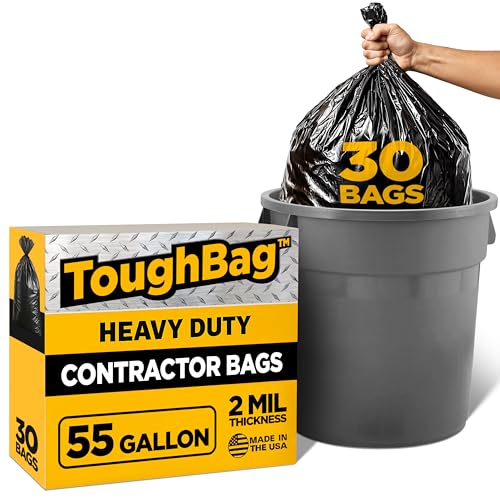
Contractor bags are in a league of their own when it comes to thickness and puncture resistance. If you are doing a renovation, clearing out a basement, or disposing of yard waste, standard kitchen bags will fail you immediately.
These bags are massive and typically come in 40-plus gallon sizes, so ensure your bin is large enough to accommodate them. They are not designed for indoor kitchen use, but they are essential for any home maintenance project.
The bottom line: Don’t use these for your daily kitchen trash, but keep a small supply in your utility closet for heavy-duty cleanup. They are the only bags that will safely hold construction debris or sharp garden clippings.
Ultrasac Commercial Liners: Best Bulk Solution

For those who prefer to buy in bulk to avoid frequent shopping trips, Ultrasac offers commercial-grade quality in large quantities. These are often sold in flat packs rather than rolls, which can actually be easier to store on a shelf in a laundry room or pantry.
They are straightforward, no-nonsense liners that prioritize strength over extra features like scents or fancy textures. They provide a consistent, reliable experience that works well for both residential and light commercial settings.
The bottom line: If you have the storage space to keep a large box on hand, these provide the best long-term value. They are ideal for busy homes that want to minimize the number of times they need to restock supplies.
Understanding Trash Bag Gauge and Thickness
Trash bag thickness is measured in "mils," which represents one-thousandth of an inch. A standard kitchen bag is usually between 0.7 and 0.9 mils, while commercial or heavy-duty bags can range from 1.2 to 3.0 mils or higher.
Don’t assume that a higher mil count is always better; a very thick bag can be stiff and difficult to tie. For most home kitchens, a bag in the 1.0 to 1.5 mil range offers the best balance of flexibility and strength.
- Low Mil (0.5–0.9): Fine for lightweight paper and plastic waste.
- Medium Mil (1.0–1.5): The "sweet spot" for kitchen trash containing food scraps.
- High Mil (2.0+): Necessary for heavy debris, sharp objects, and yard waste.
How to Measure Your Bin for the Perfect Liner
To avoid the "bag too small" disaster, you need to measure the circumference and height of your bin. Measure around the top opening of the bin and divide by two to get the bag width, then add at least 3–4 inches to ensure the bag can fold over the rim.
For the length, measure from the bottom of the bin to the top edge and add roughly 6–8 inches. This extra length is crucial for creating a secure fold-over that prevents the bag from slipping down when it gets heavy.
- Round bins: Measure the diameter and multiply by 3.14 to get the circumference.
- Square/Rectangular bins: Add the width and depth, then multiply by two.
- Pro tip: Always round up when in doubt; a slightly loose bag is far better than one that won’t reach the bottom.
Tips for Preventing Leaks in Commercial Bins
Even the strongest bag will leak if you toss liquids or sharp objects directly into the bottom. Always try to wrap sharp items like broken glass or pointy food packaging in a bit of newspaper or a paper towel before tossing them in.
If your bin is prone to leaks, consider placing a few sheets of newspaper or a dedicated absorbent pad at the very bottom of the empty bin. This acts as a safety net to catch any accidental drips before they hit the bottom of the trash can.
- Don’t overstuff: If you have to force the lid shut, you are putting too much pressure on the bag seams.
- Clean the bin: Even the best bags can get snagged on sticky residue inside the bin, so rinse your bin out every few weeks.
- Double bag: If you are dealing with particularly wet waste, double bagging is a cheap insurance policy against a messy floor.
Choosing the right trash bag is a small decision that significantly improves your daily home routine. By matching the bag’s thickness and fit to your specific disposal needs, you can stop worrying about leaks and focus on more important things. Whether you prioritize cost, odor control, or sheer strength, there is a perfect liner out there to keep your home running smoothly.